

winter tree
on tree buds and attention + book reviews & events
Somewhere in Pilgrim at Tinker Creek – the chapter on “The Present” I think – Annie Dillard asserts that sycamore is the most beautiful word in the English language. For more than a dozen years I have thought this true, and agreed with the sentiment.1
Still, the existence of the word sycamore has not kept me from developing my own list of beautiful words. It’s also a good exercise for students; I recommend it. A word must be as fine leaving the mouth as entering the ear. Summer. Wisteria. And of course it must be lovely both where it stands solitary on the page and where it lies slung across some slovenly run-on sentence. Meander. Shimmer. Moonbeam.
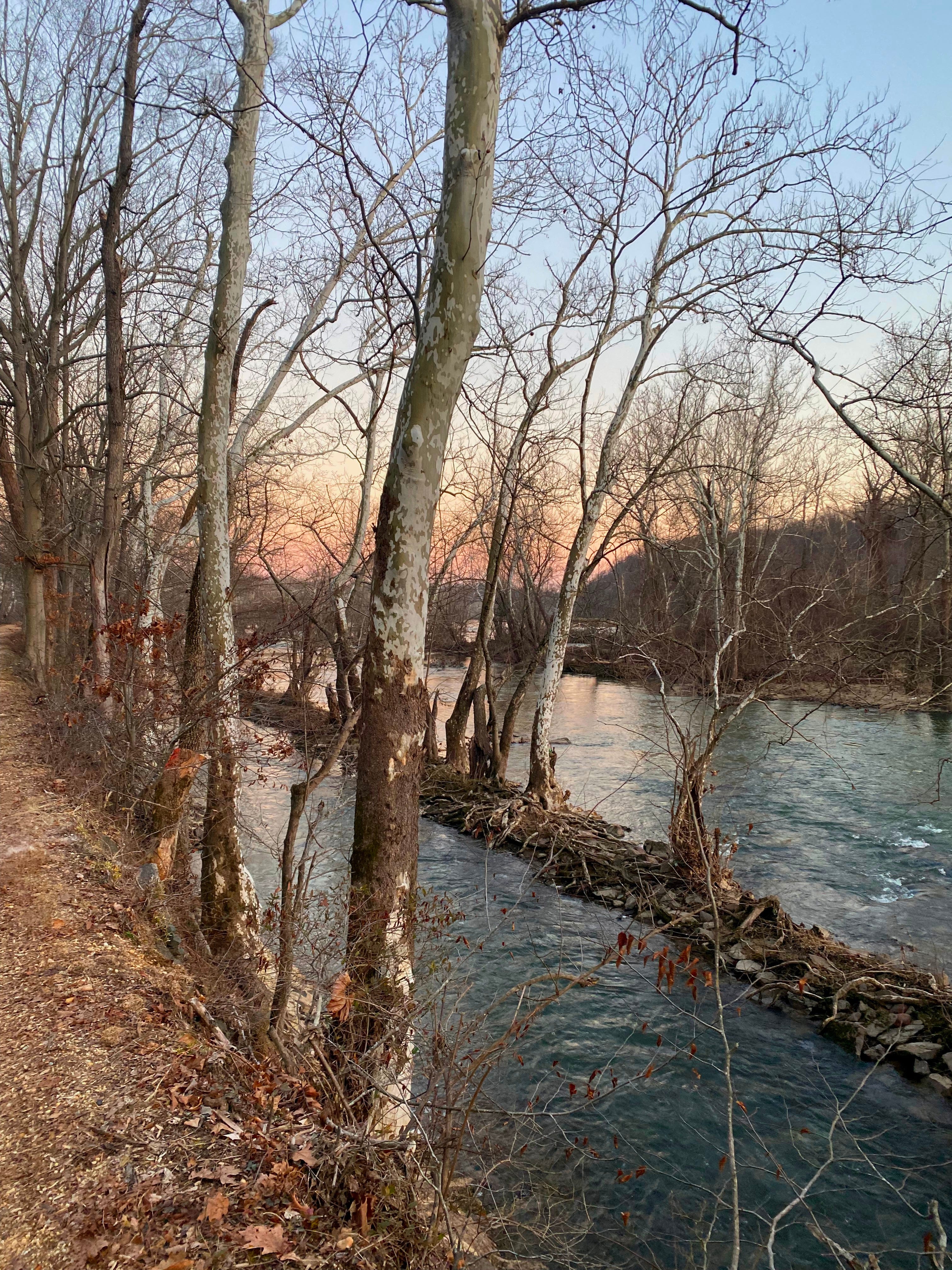
On a recent loop around Cedar Island, I got a word – well, two – stuck in my head. While they slithered around up there, repeating over and over to form a knot of soft consonants, I wondered if indeed these were the most beautiful words in English: winter tree.
I like the way the “w” offers an unsuspectingly gentle introduction before the double ee comes whistling through at the end. I don’t know if I’ve actually hit upon a new cellar door, but I like it a lot. All this last month I’ve been unconsciously repeating it like a mantra, though what I am supposed to be concentrating on and motivating myself toward, I don’t know.
It is not lost on me that there is no more wintery a tree than a sycamore. They are always one of the first trees to cast off their leaves, as if they cannot wait a day longer to show their true, unencumbered selves. By early December, along the curve in the Potomac River where I live, the sun rises over the water, and sinks on the far side over the Virginia ridge. In the morning, as the sun caps the first rocks in the river, the white-branched tops of the sycamores begin to gleam. As the sun rises, its beams slide down their bright trunks. Silver maples warm in the light, but the sycamores, white giants, glow. As the sun sets each evening, the process reverses. Shadows slide up their pale trucks until only the highest limbs flare in the weak light. Then the sun sinks below the ridge, and it’s time for me to get back home.
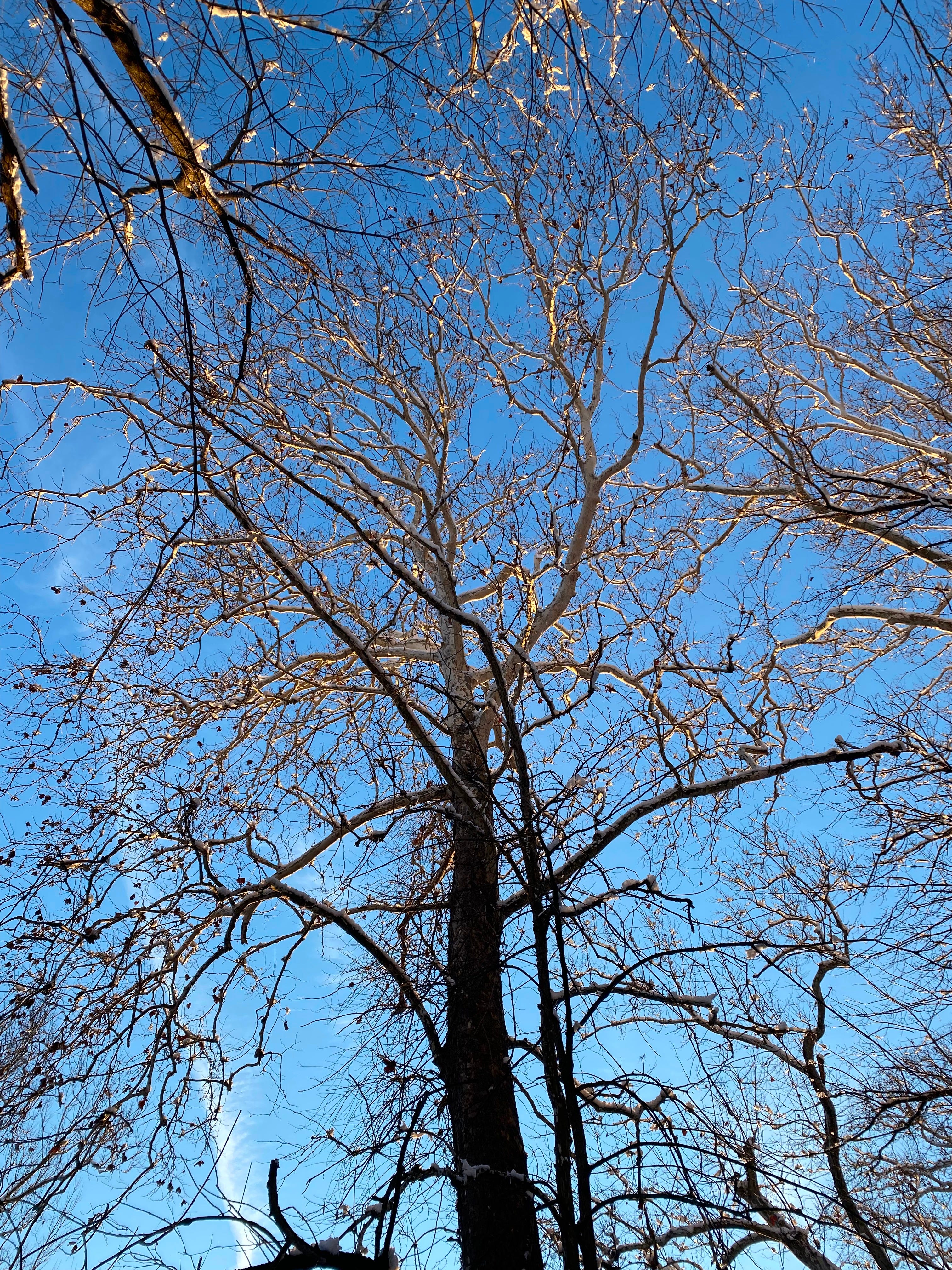
When a winter sunset stains the sky red and pink, the sycamores become a canvas for these colors. As the day softens into a cold night, these trees appear to blush and bruise. To stand on the bank and watch the slow-motion painting of the sycamores is an exquisite gift of these short weeks on either side of the solstice. This is, I’ll offer, the best time of year for these kinds of observations: the almost imperceptible, the faint, the fine.
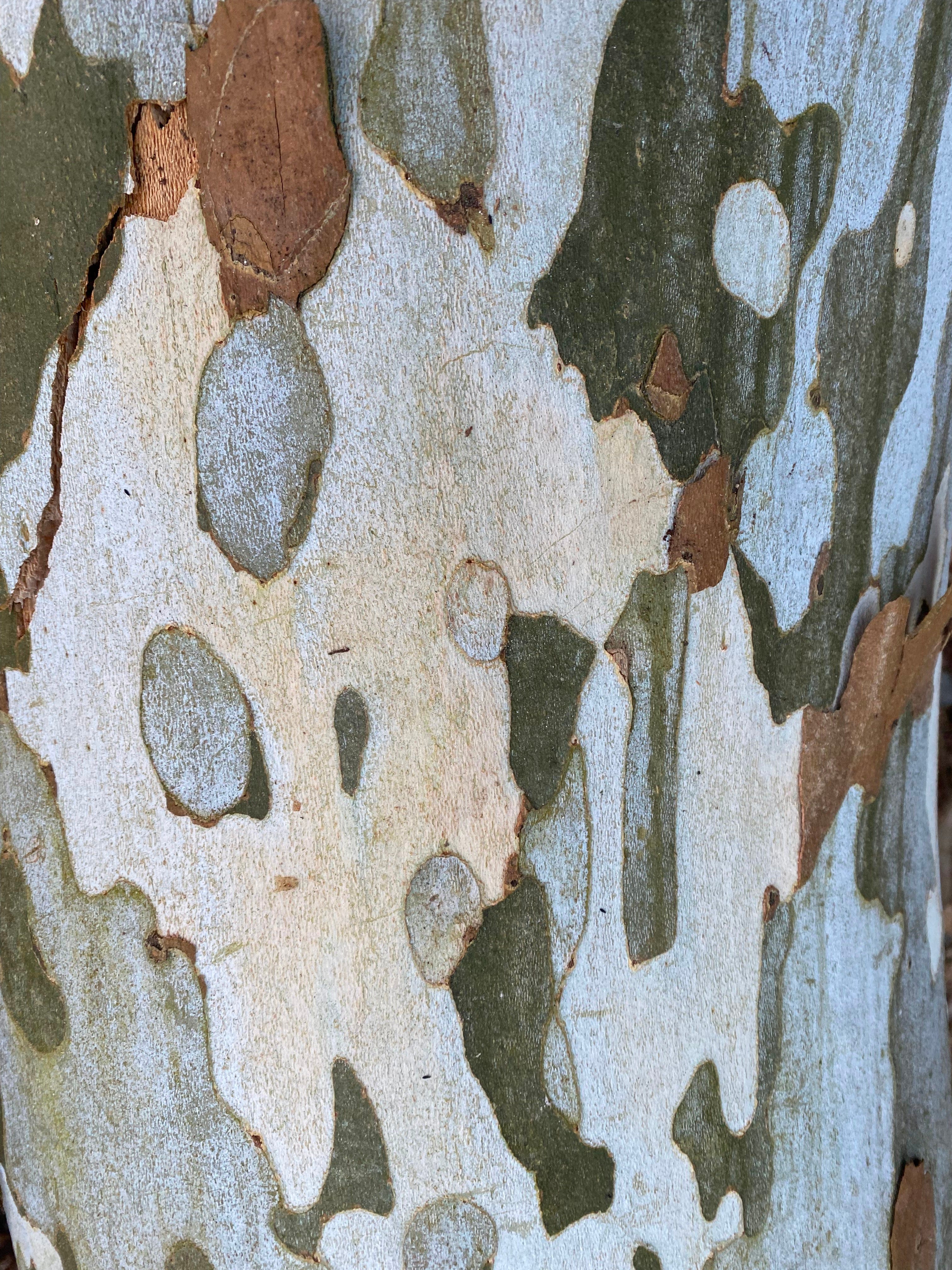
Winter tree, winter tree. It is the season when trees are at their least charismatic, and certainly their hardest to identify. You might run your hands up and down the bark and try to discern who is who that way. Trunk of white flakes, not unlike hard, dusty dandruff? Definitely a sycamore. Alligator-skin, rectangles and right angles? Persimmon. Longest ridges, deepest grooves, darkest gray? Tulip tree.
My favorite way to tell winter trees from one another is to look at their buds. Most of time we associate buds with the moments right before flowering, (See Wordsworth, “The budding twigs spread out their fan / To catch the breezy air; / And I must think, do all I can, / That there was pleasure there). But the more I sharpen my own skills at winter botany, the more I associate buds with the bitter, the raw.
All new growth on a tree is compacted inside its buds. During the humid, heavy days of August, most trees, fecund and full, produce next year’s buds. Soon, leaves fall, and buds appear from behind the foliage. Then, exposed and vulnerable, buds lie dormant for months, long before any creeping sign of spring appears. In March they’ll explode, shoot, and sprout, but for now, they rest.
Every tree species’ bud is completely unique. Some are wispy points, angular and slim; some are spheres. Some are soft, even fuzzy, some are smooth, some are scaly. A few are pink, some are yellow, some are green; many are a deceptively dull brown. Perhaps they are not quite as arresting as the flower blossoms they hold, but there’s a quiet dynamism inside – you just have to look.
The afternoon of the winter solstice I circled Cedar Island, cracking the frost heave along the edges of the trail. I put aside any pretense of real exercise, and meandered, moving slow. I know this island so intimately, or you know, I think I do. When I walk slowly, I begin to see all that I haven’t yet known – a freeze-dried chicken-of-woods mushroom (must have missed it back in November), the increased quantity of dried milkweed on the far edge near the northern spit, the quotidian miracle of tree buds.
Spicebush is one of the most common understory shrubs on the island – indeed almost everywhere along the Potomac. Their buds are shaped like small suns. Scratch along the stem, or pluck off a couple of these yellow globes, and you can smell the Mediterranean in Maryland.
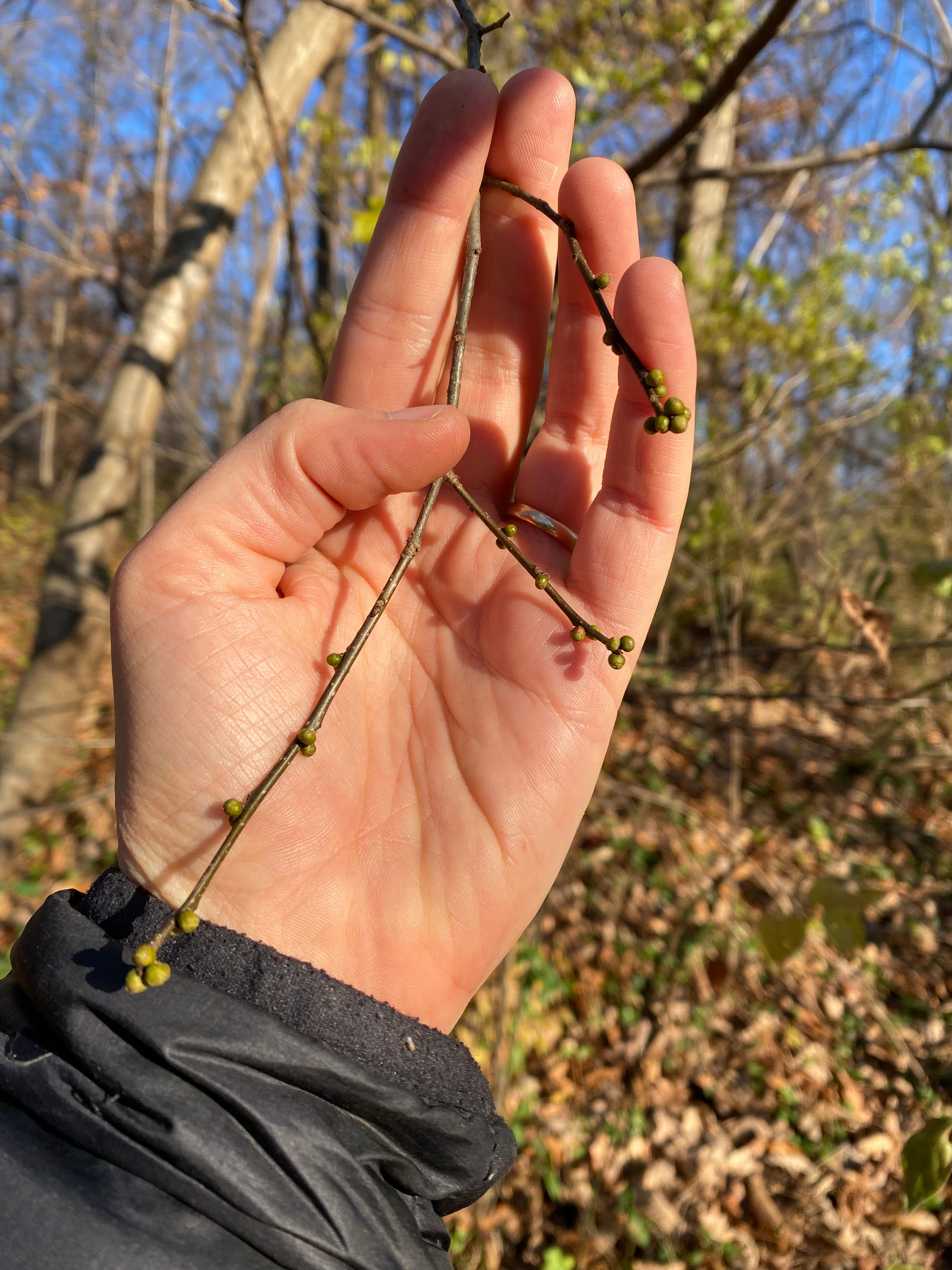
The scent of spicebush is complex – cypress, fresh pine, orange zest, and black pepper. In late winter, a week or so before the buds open into flower, I harvest a handful of stems for tea – it is a glorious treat in March, though you could just as well do it now.
I don’t remember who told me that pawpaw buds are the shape and texture of a mouse ear. I think it might be that I’ve confused the old axiom that morel mushrooms pop out in spring when oak leaves are the size of a mouse’s ear. Regardless, pawpaws in winter are now, for me at least, mouse trees, and it is hard to not want to touch (to pet?) every one of these round, velvety buds.
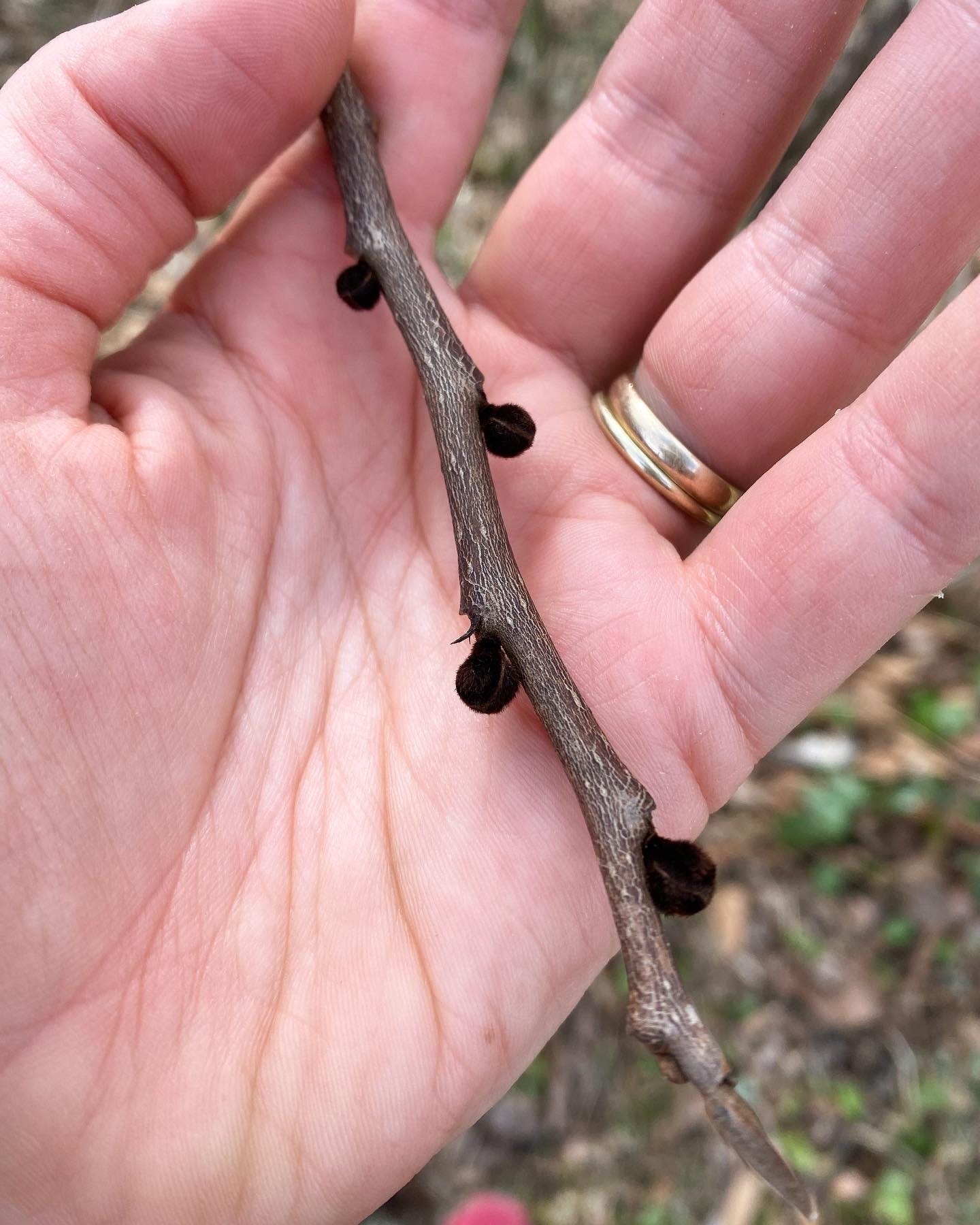
In spring, these pawpaw buds will swell and split, green petals spill out and become a dark burgundy, almost black flower. I thumb over the fuzz in January, and think of April’s flowers and the fruit of September.
How does such a simple, unassuming thing become a tree, with its vast branches and boles, leaves and flowers and fruit? There is so much mystery and wonder in these little knobs and darts you can press into nothing between your forefinger and thumb. And how easy it is to never attend to the many wild possibilities and promises held in thin sticks.
The evening after my solstice stroll, I went to my workplace holiday party, and then I holed up at home for the two-and-a-half week-long winter break. I read, I wrote, saw a few friends, went out to dinner, walked around. I did things, yes, even travelled, but on the whole I went dormant in that I was in no big hurry to work toward a goal or reach a destination.
It’s in these periods of torpid drift that I am better able to pay attention – to really see the place, people, and plants around me. “Attention, taken to its highest degree, is the same thing as prayer,” wrote Simone Weil. “It presupposes faith and love. Absolutely unmixed attention is prayer. If we turn our mind toward the good, it is impossible that little by little the whole soul will not be attracted thereto in spite of itself.”
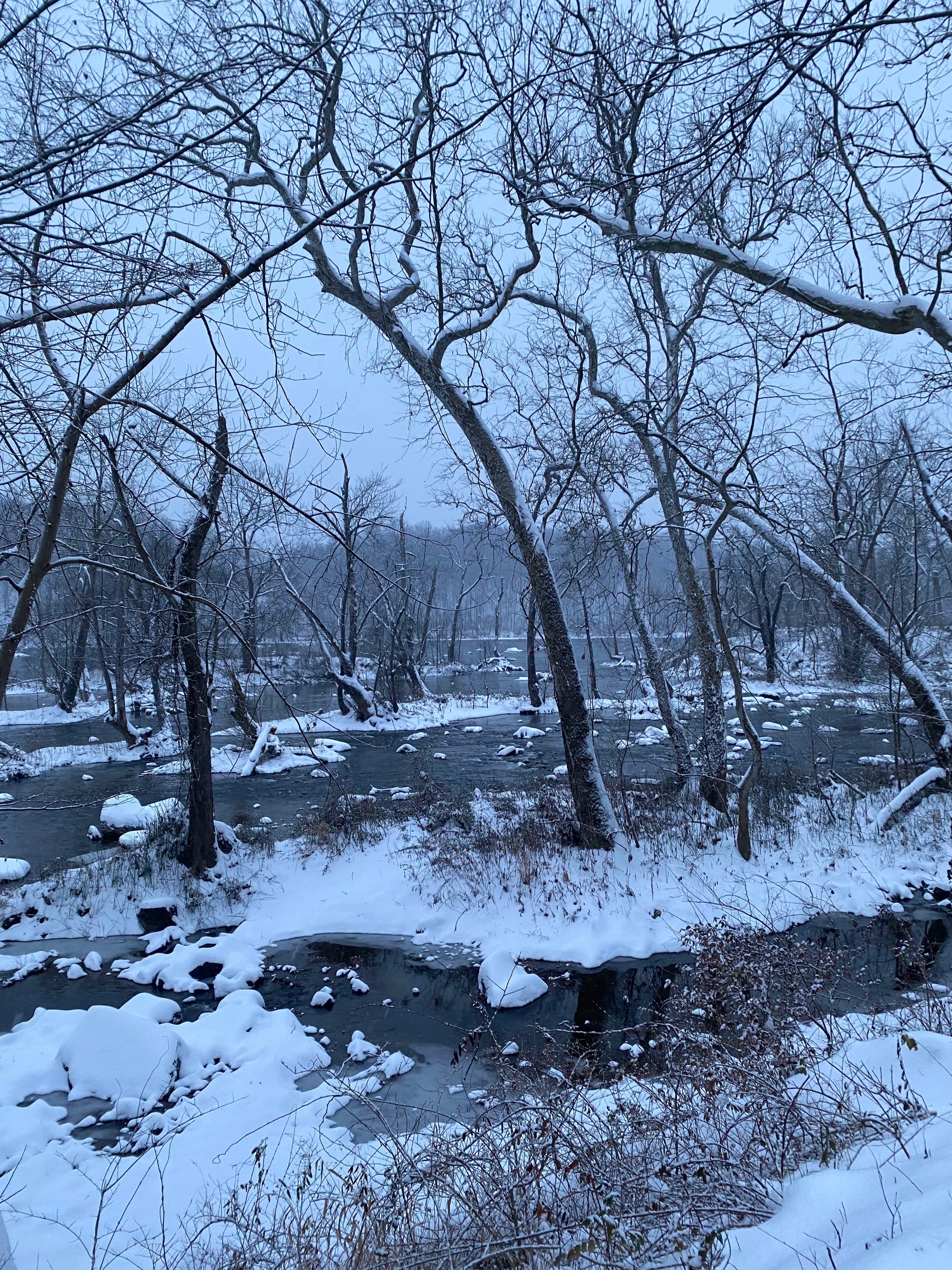
It snowed all day yesterday, the first snow of the season, the most snow we’ve had in years. I went out on a Cedar Island circle in the late afternoon, the snow still falling. I followed fox tracks across the rocky channel to Chautauqua Island, and stood in the thick of the pawpaw grove at the south end of the island. There was no sun, and so, no sunset, and yet, despite the dense cloud cover, I watched as the river slipped from gray-blue to blue-gray as the light, somewhere behind clouds, dropped behind the ridge. It felt holy to witness this, an exquisite shift in color and so too, in meaning.
As I stood there, staring out at the darkening river, I pressed my fingers against a pawpaw bud, soft and full. There is so much value in the small and simple growth of the bud, and in the slight but powerful act of giving our attention to the world around us. Winter tree, winter tree – now is the time to really look and see.
In book news
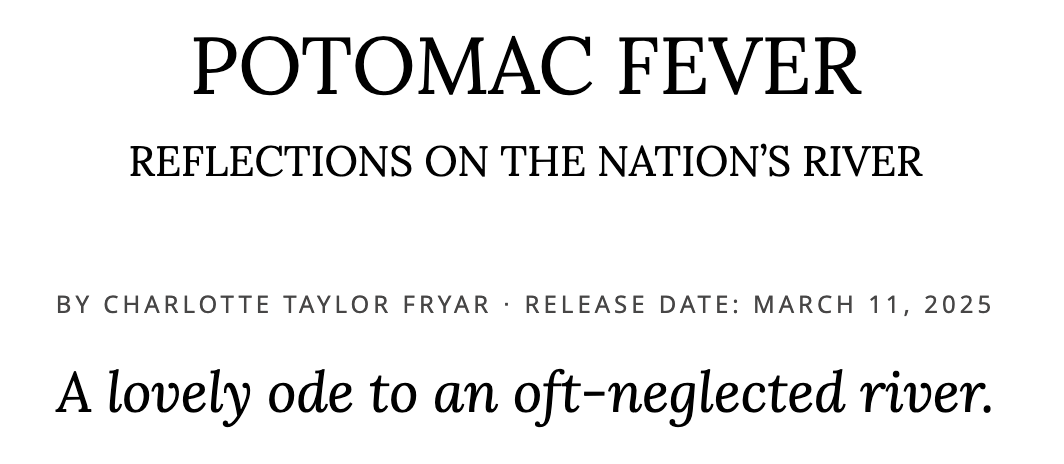
What a lovely gift to receive a few days after Christmas a particularly kind Kirkus Review of Potomac Fever:
“Written with verve and a profound understanding of the contradictions of American democracy, her book explores life in the river, in the subterranean streams that feed it, and along its shores…sing[ing] the praises of nature in the tradition of Henry David Thoreau…Readers might curl up with her book in the comfort of home or, after visiting the Lincoln Memorial and Washington Monument, take it with them on a stroll along [the Potomac].”
And our first bookseller review, from the good folks at Main Street Books in Davidson, North Carolina:
“Provocative…Starting with a love of the river and the plants around it, the evocative descriptions are joined by political and social histories that define who lives where and the impacts of pollution and climate change. An important read about a place that defines us all.”
I’m in the thick of planning book events, trying to figure out how to manage a 5-6 day-a-week teaching job with even a small tour, but we’re getting there! For now, there are three events on the calendar, including:
The book release party in Washington, D.C. at Lost City Books on Thursday, March 13th where I’ll be in conversation with my bud (get it..) Sonia Rao of the Washington Post.

On Friday, March 14th, I’ll be up in Takoma Park, Maryland at People’s Book to read and chat.

And then on Thursday, April 24th, I’ll be in Chapel Hill, North Carolina to read at the Center for the Study of the American South, my intellectual wellspring. I’ll share more on that event soon. I’ll have more events – in the DMV (and maybe North Carolina and New York) coming to you over the next month or so.
Thanks for reading — I hope you get to take a long walk in the snow.
That is until this very day, when I went looking for the exact quote in Pilgrim and discovered it was not Dillard who declared the name of these trees most pulchritudinous (okay but say it in Bill & Ted voice) but her friend, the poet Rosanne Coggeshall, one-time native of Chapel Hill, North Carolina. Rosanne - my hometown girl! What do you know about that.
Uuuugggh yesssss! What a lovely praisesong to the overlooked beauty of the bud. So good <3